$100 Million From BlackRock's Future Builders Initiative Is a Start. The Question Is Whether It Will Reach Hispanic Construction Workers.
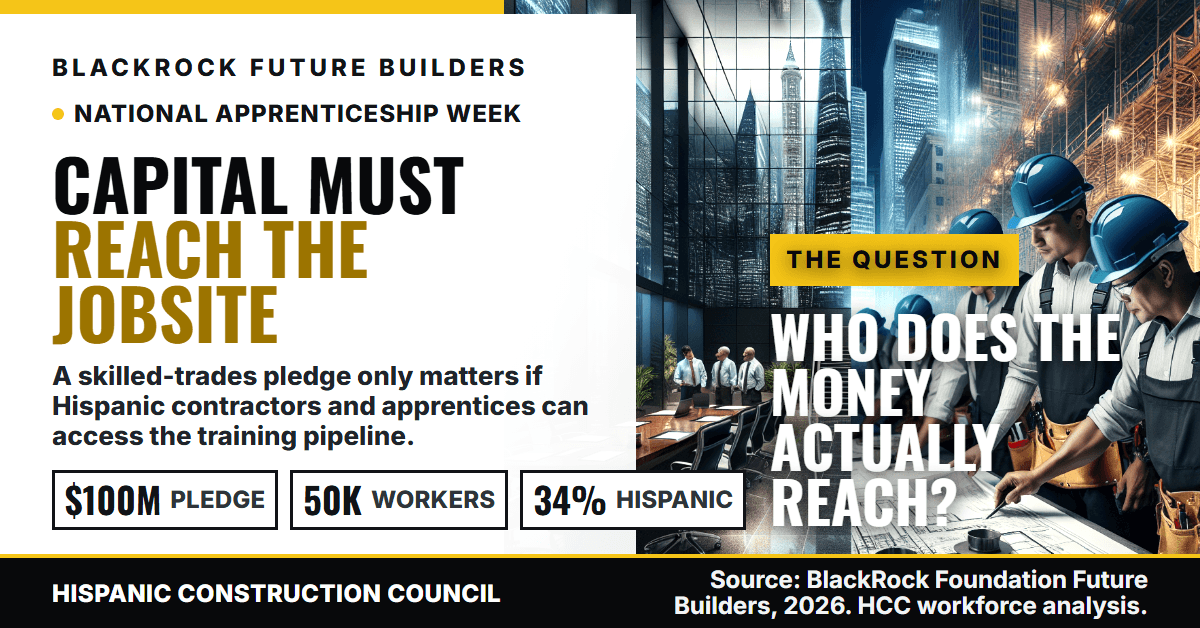
BlackRock commits $100 million to train 50,000 skilled trades workers. The question: will it reach the 34 percent of the construction workforce that is Hispanic?
By George Carrillo, CEO, Hispanic Construction Council | April 23, 2026
Three facts belong in the same sentence, and so far nobody has put them there. First: BlackRock announced on March 11, 2026, that it is committing $100 million through an initiative called Future Builders to train 50,000 skilled trades workers over five years via grants to nonprofit and workforce development organizations. Second: National Apprenticeship Week runs April 26 through May 2 this year, rebranded by the Department of Labor as Making America Skilled Again, with events across the country celebrating registered apprenticeship programs in construction, manufacturing, and the building trades. Third: the construction industry needs 349,000 net new workers in 2026, according to the Associated Builders and Contractors' 2026 Workforce Demand Report, and 92 percent of hiring firms report difficulty filling positions. Now here is the question I want answered before this week ends: are any of these programs, investments, or celebrations specifically designed to reach the 34 percent of the United States construction workforce that is Hispanic?
Why $100 Million May Not Reach the Workers Who Need It Most
The Future Builders initiative is real money moving into a real problem. BlackRock is routing the $100 million through grants to nonprofit workforce development organizations, which means the investment will reach workers only as well as those organizations are positioned to find them. I have no reason to doubt the intention behind the initiative. But intention and reach are different things. Workforce development organizations operate in networks that have historically been built around general contractors, union apprenticeship programs, and community college systems. Those networks are strong in many places. They are also consistently weaker in the subcontractor and specialty trade communities where the majority of Hispanic workers in construction are actually concentrated. If Future Builders is granting money to the same organizations that have always trained the same workforce, the initiative will produce 50,000 trained workers who look exactly like the workers those organizations have always trained. That is not a criticism of BlackRock. It is a structural observation about how workforce development investment moves and who it finds.
The Hispanic Construction Apprenticeship Gap Is Documented and Correctable
National Apprenticeship Week is a genuine opportunity to highlight the economic argument for registered apprenticeship programs, and the Department of Labor deserves credit for the effort. But the celebration will be more meaningful if the data behind it is honest. The HCC's 2026 State of Hispanics in Construction Report documents this gap directly. Hispanic workers represent 34 percent of the construction labor force nationally, according to the Bureau of Labor Statistics' Current Population Survey (2025). Their enrollment and completion rates in registered apprenticeship programs consistently trail that representation across the states that track demographic data, a gap the report attributes not to lack of interest but to structural barriers in how apprenticeship sponsorship and access are organized. The gap has multiple causes, including language barriers in testing and credentialing, access to apprenticeship sponsors through firm networks that small Hispanic-owned businesses are often outside of, and program structures that assume a full-time, shift-compatible schedule that does not reflect the actual work patterns of many skilled Hispanic tradespeople. Celebrating National Apprenticeship Week without acknowledging that gap is a missed opportunity.
What HCC Is Asking BlackRock and the Department of Labor This Week
Here is the specific ask I am making this week. BlackRock should publish demographic data on Future Builders grant recipients and commit to a goal for the percentage of trained workers who are Hispanic. Fifty thousand workers over five years is only meaningful as an equity investment if the people most underserved by the current training infrastructure are disproportionately included in the count. The Department of Labor should require National Apprenticeship Week participating programs to track and report Hispanic enrollment rates, not just total enrollment. The 349,000-worker construction gap documented by ABC will not be solved without the workforce that represents a third of the industry's existing labor supply. Any national training investment that does not explicitly route capital toward that workforce is leaving the most available labor pool in the country underutilized.
The construction industry is not running out of people who want to do this work. It is running out of systems that effectively credential them, connect them to sponsors, and move them into the programs that lead to higher wages and long-term career pathways. The HCC has spent the past year building the policy and data case for exactly this argument, and the Future Builders initiative and National Apprenticeship Week together create a rare moment when the public conversation is already on workforce development. HCC is prepared to work with BlackRock, the Department of Labor, and any workforce development organization that wants to specifically route this investment toward the Hispanic construction workforce. Contact us at hispanicconstructioncouncil.org.
$100 million and a week of national attention are an unusual convergence. The question is whether the organizations and agencies behind them are willing to ask who is not yet in the room and to do the specific work of changing that. The answer will determine whether National Apprenticeship Week 2026 is a celebration or a turning point.
George Carrillo is the founder and CEO of the Hispanic Construction Council. He is a United States Marine Corps veteran, a former law enforcement officer, and a construction industry leader focused on workforce equity and policy reform.
Sources: BlackRock, Future Builders Initiative (BlackRock.com, March 11, 2026). U.S. Department of Labor, 2026 National Apprenticeship Week announcement (DOL.gov, January 28, 2026). Associated Builders and Contractors, 2026 Construction Workforce Demand Report. Bureau of Labor Statistics, Current Population Survey (2025). HCC 2026 State of Hispanics in Construction Report.
George Carrillo
CEO, Hispanic Construction Council
George Carrillo is the founder and CEO of the Hispanic Construction Council, the leading research and advocacy organization for Hispanic workers and businesses in the U.S. construction industry. He has spent his career at the intersection of construction, data, and policy.
Frequently Asked Questions
Will BlackRock's Future Builders initiative reach Hispanic construction workers?
HCC is asking BlackRock to publish demographic data on Future Builders grant recipients and commit to a specific goal for the percentage of trained workers who are Hispanic. Without explicit routing toward the Hispanic construction workforce, investment through existing nonprofit networks risks repeating historical patterns that have underserved this community.
What percentage of the construction workforce is Hispanic?
Hispanic workers represent 34 percent of the U.S. construction labor force nationally, according to the Bureau of Labor Statistics Current Population Survey (2025). Despite representing a third of the construction workforce, Hispanic workers are consistently underrepresented in registered apprenticeship programs.
What is the construction workforce gap in 2026?
The construction industry needs 349,000 net new workers in 2026, according to the Associated Builders and Contractors 2026 Workforce Demand Report. 92 percent of hiring firms report difficulty filling positions. Hispanic workers, who make up 34 percent of the existing construction workforce, represent the most available labor pool for closing this gap.
What is BlackRock's Future Builders initiative?
BlackRock announced on March 11, 2026, a commitment of $100 million through the Future Builders initiative to train 50,000 skilled trades workers over five years. The investment is routed through grants to nonprofit workforce development organizations working in construction, manufacturing, and the building trades.
Why are Hispanic workers underrepresented in registered apprenticeship programs?
The HCC 2026 State of Hispanics in Construction Report identifies multiple structural barriers: language barriers in testing and credentialing, limited access to apprenticeship sponsors through firm networks that small Hispanic-owned businesses are often outside of, and program structures that assume schedules that do not reflect the actual work patterns of many skilled Hispanic tradespeople.
Access Full Research
Get complete access to all HCC workforce analysis, state reports, and industry data with a membership.
Join HCC2026 State of Hispanic Construction
Download the comprehensive report on 4.2M workers, 95,000+ businesses, and the policy landscape.
Download ReportRelated Articles
More from HCC
View All ArticlesHispanic Construction Workers Are the Backbone of American Infrastructure
With 4.2 million workers representing 35.2% of the entire U.S. construction labor force, Hispanic workers are not just participants in American infrastructure. They are its foundation.
87 Cents on the Dollar: The Wage Gap in Construction and How to Close It
Hispanic construction workers earn 87 cents for every dollar earned by non-Hispanic counterparts in equivalent positions. The gap is persistent, documentable, and addressable through specific policy interventions.
Apprenticeship Programs Are Leaving Hispanic Workers Behind. Here Is How to Fix It.
The United States has invested heavily in construction apprenticeship programs. Yet Hispanic workers, 35% of the construction workforce, are underrepresented in registered apprenticeship completions. The systems are not built for them.